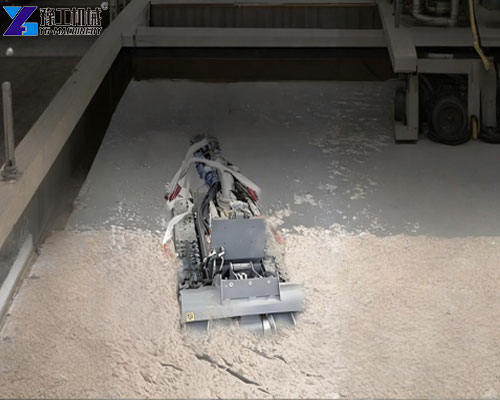
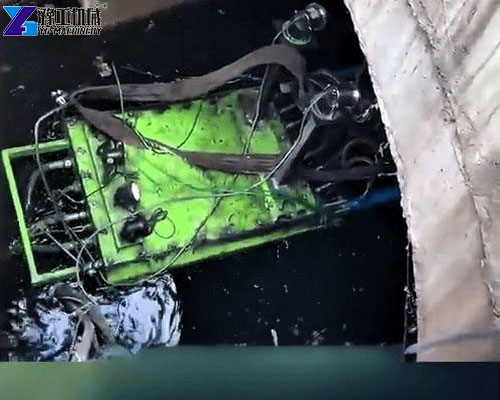
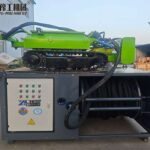
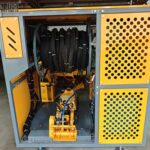
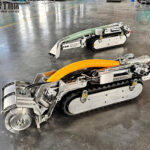
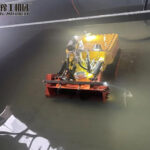
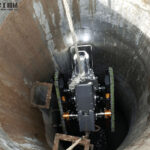
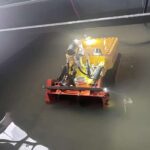
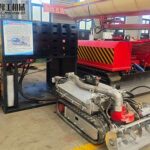
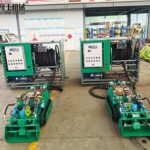
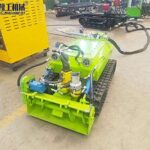
A wastewater sludge removal robot is a remote-controlled machine designed to remove settled sludge, sediment, and other accumulated solids from wastewater tanks without requiring workers to enter the tank.
Instead of draining a tank or relying entirely on manual cleaning, the robot can move through the tank, break up accumulated sludge, add water when necessary, and pump the resulting slurry to a designated discharge point.
With different robot sizes, pumping capacities, and cleaning configurations available, the system can be adapted to wastewater tanks with limited access, thick sludge, long pumping distances, or other challenging cleaning conditions. For broader wastewater treatment plant desilting applications, see our wastewater treatment plant desilting robot.
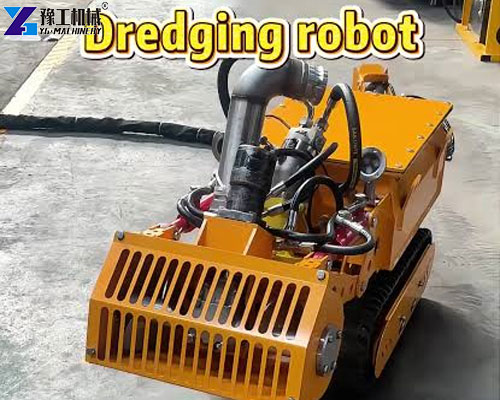
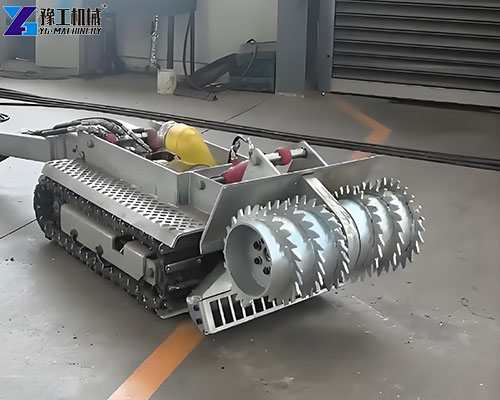
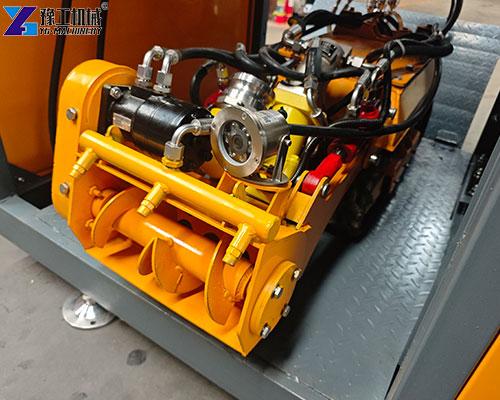
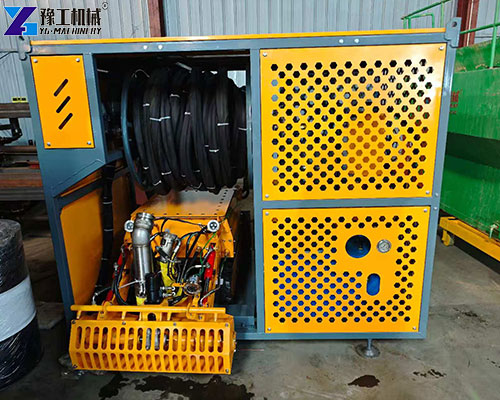
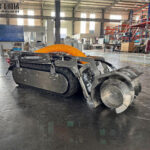
A wastewater sludge removal robot combines a crawler platform, sludge-breaking equipment, water jetting, and a transfer pump into one remote-controlled cleaning system.
It is designed for applications where sludge accumulates at the bottom of wastewater or treatment tanks and conventional pumping cannot efficiently remove the material.
The robot can be configured according to:
Tank access width and height
Sludge thickness and concentration
Tank depth and dimensions
Sludge particle size
Required pumping capacity
Pumping distance and elevation
Available power supply
This makes it suitable for different wastewater tank sludge removal requirements rather than relying on one fixed machine configuration.The system is based on a remote-controlled dredging robot designed for sludge breaking and pumping in challenging wet environments.
The robot is primarily designed for accumulated sludge and sediment that can be broken up and converted into pumpable slurry.
Typical materials include:
Settled wastewater sludge
Thick sludge deposits
Sediment mixed with wastewater
Sludge containing sand or small solid particles
Compacted deposits at the bottom of tanks
When sludge is too thick or compacted for direct pumping, the cleaning process can be adjusted to improve pumpability.
The actual configuration depends on the sludge properties, including thickness, concentration, particle size, and how strongly it has settled or compacted.
Key Features of the Wastewater Sludge Removal Robot
Remote-Controlled Operation
The operator controls the robot from outside the tank. This reduces the need for personnel to enter areas containing accumulated sludge or wastewater.
Compact Crawler Design
The crawler platform allows the robot to move across the tank bottom while maintaining traction in wet and muddy conditions.
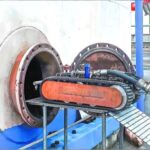
Different machine sizes can be selected according to the available tank access.
Sludge Breaking and Water Jetting
A combination of mechanical sludge breaking and high-pressure water jetting helps loosen compacted deposits and prepare them for pumping.
Powerful Sludge Pumping
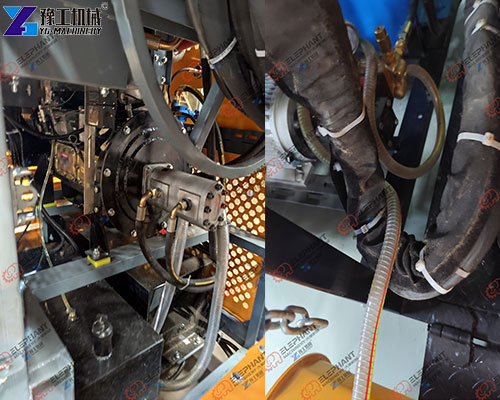
The transfer pump is selected according to sludge concentration, pumping distance, required capacity, and site conditions.
For example, the YG series can be configured with pumping capacities from compact-tank applications up to approximately 250 m³/h, depending on the model and working conditions.
Remote Monitoring
A camera and lighting system can help the operator observe the working area while controlling the robot remotely.
This is particularly useful when visibility inside the tank is limited.
Different tank conditions require different robot sizes and pumping configurations.
YG450
Compact wastewater tanks and restricted-access areas
Small access requirements and flexible operation
YG900
Medium to large tanks with heavier sludge
Higher cleaning and pumping capability
YG1200
Large-scale sludge removal applications
High-capacity pumping, up to approximately 250 m³/h depending on configuration
Model selection should not be based on tank volume alone. Access size, sludge properties, pumping distance, and required cleaning capacity should also be considered.
How to Choose and Customize a Wastewater Sludge Removal Robot
The right wastewater sludge removal robot depends on the tank and sludge conditions. Key factors include:
Tank access: Opening size and available entry space
Sludge condition: Thickness, concentration, and particle size
Tank dimensions: Length, width, and depth
Pumping requirements: Distance, discharge height, and required capacity
Power supply: Electric or diesel
Based on these conditions, the robot can be customized with the appropriate robot size, sludge-breaking head, high-pressure water jet, transfer pump, discharge pipeline, and power system.
Provide the tank dimensions, access size, sludge condition, and pumping requirements to determine the suitable YG450, YG900, or YG1200 configuration.
It is a remote-controlled crawler machine designed to break up and pump accumulated sludge from wastewater tanks without requiring operators to enter the tank.
Can the robot remove thick sludge?
Yes. Thick or compacted sludge can be mechanically broken and diluted with water before pumping. The appropriate configuration depends on sludge thickness and concentration.
Can it pump sludge over a long distance?
The pumping distance depends on the pump configuration, pipeline diameter, elevation, and sludge characteristics. These parameters should be confirmed before selecting the pump.
What tank access size is required?
The required access size depends on the selected robot model. Compact models such as the YG450 are designed for more restricted entrances.
Which model should I choose: YG450, YG900, or YG1200?
The choice depends on tank access, sludge condition, required capacity, tank dimensions, and pumping distance. A larger model is not necessarily required simply because the tank is large.
Can the wastewater sludge removal robot be customized?
Yes. Robot dimensions, pump capacity, sludge-breaking equipment, water-jet system, pipeline length, power system, and other components can be configured according to the project.
Get a Wastewater Sludge Removal Robot for Your Tank
Choosing the right wastewater sludge removal robot starts with understanding the actual tank and sludge conditions.
If you provide the tank dimensions, access opening, sludge thickness, sludge concentration, particle size, pumping distance, discharge height, and power supply, the appropriate robot model and cleaning configuration can be determined for your application.
The result is a wastewater tank sludge removal system designed around the actual cleaning conditions rather than a standard machine configuration.